Somewhere between the 9th interview round and the 14th must-have bullet point, a lot of companies quietly lose the people they were hoping to hire.
Not because there’s no talent.
But because they’re chasing someone who doesn’t exist: The perfect engineer.
What the “Perfect” Engineer Looks Like (on Paper)
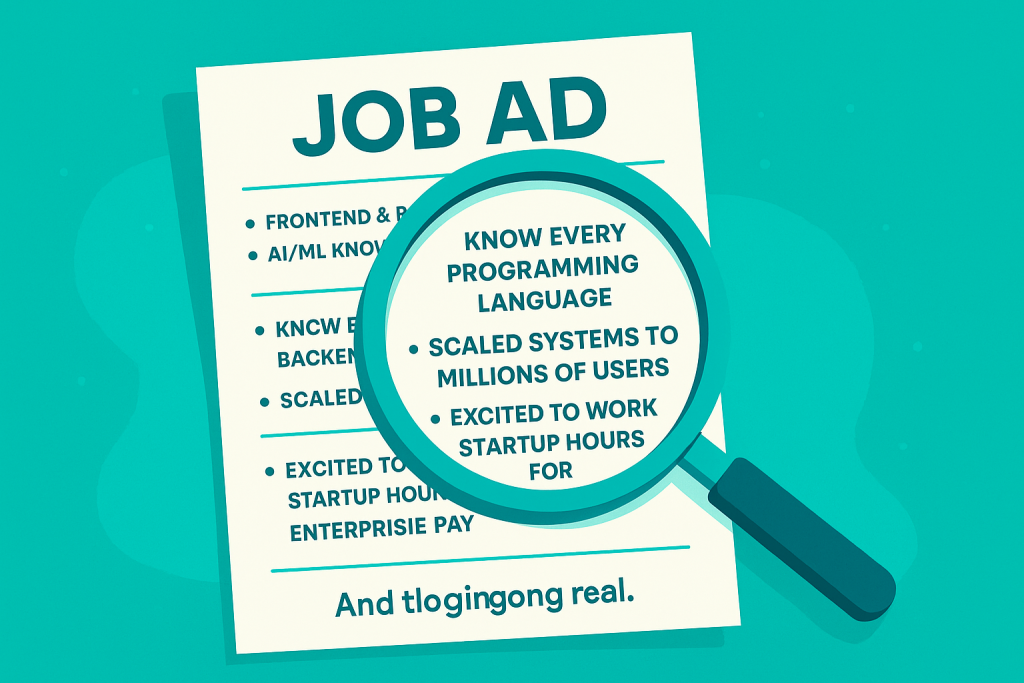
They know every language your stack touches—even the ones you’re planning to phase out.
They’ve scaled systems from 0 to millions, led teams, and are still hands-on coders
They love startups, but also want enterprise polish.
They want to be challenged, but not too much.
They’re local. Or remote. But definitely in your time zone.
They’re affordable.
And they’re not real.
What Happens When You Search for This Person
You write a job description that reads like three roles mashed into one
You get flooded with mismatched applicants
Your hiring team spends hours filtering, rejecting, and circling back
You finally talk to someone great—and lose them to a faster, more focused company
Meanwhile, you think it’s a “talent shortage.” But what’s really happening is you’re filtering out everyone who might actually be great because you’re holding out for an ideal that doesn’t exist.
How It Feels on the Candidate Side
Let’s flip the script.
Imagine you’re a backend developer with 7 years of solid experience. You’ve worked in microservices, dabbled in DevOps, led some projects. You see a job post looking for exactly that—but also:
Frontend expertise in React
AI/ML “nice to have”
Experience managing 12+ people
Based in Warsaw, fluent in English and German
Oh, and must be excited to work startup hours for enterprise pay
You’d skip it. And they do.
The Real Risk: Losing Good for the Sake of Perfect
We’ve seen it over and over: Teams waiting for the “perfect fit” often miss out on good people—ones who’d do the job well and actually join.
Good hiring is about fit, potential, and real-world needs—not fantasy checklists.
And when companies shift that mindset, everything gets easier:
Job posts attract the right kind of people
Interviews get more focused
Offers are accepted faster
Teams stop burning out waiting for “the one”
So What Should You Look For?
Instead of chasing perfection, ask:
What’s truly essential on day one?
What can be learned on the job?
What kind of person succeeds on this team, not just in general?
Great engineers come in different shapes—and the best ones often aren’t perfect on paper.
They’re curious. Adaptable. Reliable. And they’re out there—if you know how to look.
Where We Come In
At Meettal, we help tech teams get clear on what they actually need—and find people who match that.
Not resumes that check every box. Not unicorns. Just smart, capable humans who can build real things with you.
Hiring doesn’t have to be a never-ending search for perfect. It just has to be right. Let’s talk.
Some team members are just harder to work with… or are they?
In this insightful breakdown, Mariana Edilyan challenges the idea of “difficult” employees and offers practical advice on how to better understand and work with 15 different personality types that often cause friction in teams.
Whether you’re leading a team or simply navigating workplace dynamics, this resource is packed with actionable strategies to help you turn potential challenges into opportunities for growth.
Struggling to find the right leadership balance? These 10 powerful contrasts, suggested by Justin Wright, will help you lead with clarity, confidence, and compassion.
Have you ever wondered if your people are on the same page or not? You need to ask these 5 questions suggested byVince Sanderson to give you an insight.
Please reflect upon how you think the team would answer these questions, then ask them and then of course, compare your results.
5 questions to find out if your team members are on the same page
1. If we interviewed each team member separately would they give similar answer about the team goals, priorities and vision?
Meaning if you would ask each one separately about strategy of the team, goals and objections, about what priorities you all have as a team for this year and for upcoming year, what would be the answers, here the most important thing to see how similar or how close the answers are.
2. Do team members have a collective understanding of the role, other’s roles and where they connect?
In this case it is very important that each team member would have a clear understanding about their own role in the team and then next important team is that every team member should know the functions and responsibilities of his/her colleagues and role in the whole team picture. Of course vitally important is that everyone see how all these roles are connected within the team.
3. Do they know who knows what?
Every team member has unique knowledge and experience and it is important that members of one team really know about each other’s areas of expertise.
4. If your team faced a significant challenge next month, would each person know what they need to do?
There always will be different problems and issues to solve, and it is important that your team members clearly know what each of them should do in case there is a significant challenge.
5. When problems arise do they have a clear process to voice their concerns and realign their efforts?
This question refers to clear processes in your company and in your team for problematic and complex cases. Is there a platform where employees can voice their issues? Do you have clear mechanism and procedures so that problems are solved in a fair and structured way.
Reflect upon about how the team would answer these questions, then ask them and then compare the two.
HR professionals must possess strong emotional intelligence, team management skills, leadership abilities, and a deep understanding of employee motivation. Animated films can offer valuable insights into these key HR competencies. Here are five animated movies that provide essential lessons for HR professionals.
1. Inside Out (2015)
Key Themes:
Emotional Intelligence (EQ)
Workplace Stress Management
Adaptability to Change
What HR Can Learn from This Movie
This film visually represents how different emotions influence people’s behavior and decision-making. HR professionals should develop a keen understanding of employees’ emotional states and foster psychological safety in the workplace.
Skills to Develop:
Empathy and understanding employee needs
Enhancing emotional intelligence
Flexibility and adaptability to change
2. Soul (2020)
Key Themes:
Meaning of Work and Self-Realization
Motivation and Career Satisfaction
Work-Life Balance
What HR Can Learn from This Movie
“Soul” highlights how people often chase an “ideal career” while neglecting true fulfillment. HR professionals should support employees in finding their passion, preventing burnout, and creating opportunities for growth.
Skills to Develop:
Identifying true employee motivation
Promoting work-life balance
Creating self-development opportunities in the workplace
3. Zootopia (2016)
Key Themes:
Diversity, Equity, and Inclusion (D&I)
Overcoming Stereotypes
Cultural Intelligence
What HR Can Learn from This Movie
The movie demonstrates how discrimination and biases hinder individual growth. HR professionals must ensure equal opportunities in the workplace and foster a culture that embraces diversity and inclusion.
Skills to Develop:
Managing workplace diversity
Enhancing inclusion within the organization
Developing fair and unbiased HR policies
4. The Incredibles (2004)
Key Themes:
Teamwork
Managing Individual Talents
Work-Life Balance
What HR Can Learn from This Movie
Each individual has unique strengths and weaknesses. This film highlights the importance of properly managing team members’ unique skills while also encouraging a balance between work and personal life.
Skills to Develop:
Building and unifying teams
Recognizing employees’ strengths
Conflict resolution in teams
5. Ratatouille (2007)
Key Themes:
Discovering New Talent
Creating Opportunities for Everyone
Organizational Growth Strategies
What HR Can Learn from This Movie
The movie teaches that talent knows no boundaries. HR professionals should be able to recognize and nurture hidden talents, regardless of background or experience.
As a tech recruiter, one of the most challenging aspects of my job is negotiating with top talent in the industry. The competition is brutal, and it takes more than just offering a generous salary package and a bunch of benefits to be able to hire talent. It requires a set of negotiation tactics that can help to attract and recruit the best tech professionals.
I want to share some effective negotiation tactics that have helped me secure strong tech talent for my clients. These tactics are mirroring, tactical empathy, and labeling the candidate’s emotions.
Mirroring: building rapport and establishing trust
Mirroring is a subtle technique that involves mimicking the other person’s body language, tone of voice, and choice of words to build rapport and establish trust. It can make the candidate feel more comfortable and relaxed, reducing tension and creating a favorable negotiating environment.
To effectively mirror a candidate, you need to pay attention to their tone of voice and choice of words.
At the earlier stages of the recruitment process, you have written text (reach-out messages) or phone/video calls as your only way to communicate with the potential candidate.
Since you don’t see each other in person, as a recruiter, you should focus more on their choice of words and their tone of voice. However, be careful when matching someone else’s tone of voice. If they sound frustrated or aggressive, your tone of voice should remain calm and balanced. So instead of mimicking them, try to establish trust with a calm and measured attitude.
Matching the tone of voice
Matching someone’s tone of voice starts with analyzing their communication style. Before I even start writing to the candidate, I take a moment to explore their style. I look at the language they use when posting on LinkedIn or other social media channels or when replying to comments or posts. This gives me a pretty good understanding of how the candidate likes to communicate.
Once I have analyzed the candidate’s communication style, I try to use a similar language style when writing to them. I use words and phrases they are familiar with, and I try to use a similar tone and voice.
However, keeping it professional is key since you represent a company, and the candidate probably doesn’t know you in person.
Another key aspect of matching someone’s tone of voice is ensuring your message is clear and concise. This means I avoid complex language or technical jargon unless the person uses them themselves.
Lastly, when matching someone else’s tone of voice, it’s important not to lose yours or fake a communication style. It’s not about duplicating the other person’s style; it’s more about finding common ground that works for both of you.
Tactical empathy: understanding the candidate’s perspective
Tactical empathy is putting yourself in the candidate’s shoes and understanding their perspective. By doing this, you can gain valuable insights into what motivates them, what their concerns are, and what they are looking for in a job. This information can help you tailor your negotiation approach to meet their needs and interests better.
To practice tactical empathy, I do active listening. I pay close attention to what the candidate is saying. I then ask open-ended questions encouraging them to share more about their perspective. The more I learn about their attitude, objections, concerns, and needs, the better I can tailor my negotiation approach.
I sometimes also use one of the so-called reflective listening techniques – I summarize what they have said and check if I have understood their point of view correctly. For example, “I don’t want to change my job right now. I am happy doing what I do in my current company especially considering that they are a growing startup and I got a big stock share there.” I could add to this, “It seems it’s not an easy decision to leave a startup that offers you an interesting job and great stock options.”
Instead of jumping into bringing arguments and shouting about facts on why they should leave their current job, I summarize what they say, and this helps the candidate feel heard.
Labeling the candidate’s emotions: validating their feelings
We all experience emotions, whether positive or negative, about our jobs. Labeling the candidate’s emotions involves validating their positive and negative feelings. By doing this, I show the candidate that I understand and respect their emotions. This helps me build trust and strengthen my relationship with the person I am in contact with.
When talking to the candidate, I pay close attention to their verbal and nonverbal cues (if the conversation happens in person). When I notice the candidate is experiencing a particular emotion, I try to label it by saying something like, “It sounds like you value work-life balance a lot” or “It sounds like you feel excited about an opportunity where you can take the lead on X, Y, Z” or “It looks like you are frustrated by the lack of proper processes for managing X, Y, Z.”
By doing this, I am demonstrating empathy and showing that I am paying attention to their concerns. This can help to build trust. Later, when the time is right, I can use all that has been said to me to try and “sell” the work-life balance or the nicely-established processes in a company I am offering them to join.
Final notes
Mirroring, tactical empathy, and labeling the candidate’s emotions are great negotiation tactics I use regularly. However, the key point for success here is that I don’t rush their decision-making. I’ve had candidates on my radar for months, if not years, whom I’ve been in constant contact with. I kept listening to their perspective and gathering insights about them until I could offer them the right opportunity that would minimize their objections (that I already knew of) and maximize the possibility of them agreeing to attend an interview or speak with my client.
Why Hire Female Leaders (especially in a small market)
How many women do you know in leadership positions? Are they good? How do you feel about having more female leaders in a small market like Armenia?
In small markets, gender diversity is still a pretty sensitive topic. We don’t talk about it enough.
However, women bring a set of unique values to organizations. And I feel strongly about hiring them.
Gender diversity and inclusion are critical issues that have started being addressed in certain areas of the world. However, despite progress in many fields, discrimination against women in small markets still prevails.
Women often face unique challenges that most men do not – for example, they are often perceived as too emotional, not confident, or assertive enough.
As a female leader, it takes a lot of effort to get business-critical decisions approved. You need to provide enough context and enough evidence to make your voice heard and your judgment supported by other women and men equally.
Additionally, you often have to explain things (and yourself), unlike men whose thinking or decisions are not questioned so often. To be fair, a lot of male leaders do support women. But, as a female leader, I’ve heard things like, “Yes, problems exist, but don’t overthink them. Just act and do what you are good at.”
My understanding is that you overcome a problem by thinking it through, speaking it out, and opening up a conversation around it. Experiencing a problem and ignoring its existence is like hiding an elephant in a room, isn’t it?
So here is the problem – as a woman leading a tech recruitment agency in a small market, I think not believing in women and not giving them the chance to lead teams is a huge mistake based on gender bias.
Why should business owners or managers in a small market consider hiring women? The answer is – women bring a unique perspective and skillset to the table that can help a business grow and thrive.
Women are often better at addressing the unique needs of female employees
One of the first housekeeping and women-centric decisions I made when I joined meettal was introducing period leave for women and adding hygiene products for women in the office. These two simple yet oftentimes overlooked little perks usually make a big difference for women employees by significantly affecting their comfort and productivity.
Employee engagement is boosted
Research shows that companies with more women in leadership positions have higher levels of employee engagement. This is because women tend to be more collaborative and inclusive, which creates a positive work environment. Employees who feel valued and included are more likely to be motivated to perform their best work.
Women in top leadership roles increase productivity and earnings
Studies have also shown that companies with more women in leadership positions tend to have better financial performance.
A study by Credit Suisse concluded that companies with 25% of women in decision-making roles had a 4% higher average return on investment, and companies with 50% of women in senior leadership had a 10% higher cash flow return on investment.
This is likely because female leaders tend to be more risk-averse and focus on long-term goals, which can lead to more sustainable growth.
Female leaders bring a diversity of thought to the table
Women have historically been underrepresented in leadership positions. That’s why now they bring a unique perspective to the table – ideas and values never really heard of before, especially in male-dominated markets.
While it may take us, women, more time to validate a decision, our unique values can lead to a better workplace environment, improved employee morale, and boosted work ethics. Because we have to explain our choices so often, we are often more careful and thoughtful in our decision-making, which can result in more long-term success for a business.
Disclaimer: representation matters, but it’s not a rule
Having women in leadership positions is a powerful message that women, too, can achieve their career goals. However, breaking down barriers and creating a more diverse workforce might not be the top priority for an average business in a small market.
For business owners, a few business-critical priorities are employee engagement and productivity and higher return on investment. If a female leader can get the business there, they should be given the chance to do that.
I am by no means arguing that women lead better than men do. However, women should be provided an equal opportunity to lead and help a business thrive. Because, more often than not, women prove to be great at doing that.
If you’re having goosebumps listening to the word plagiarism, I can relate! Let’s explore this a little further.
A Brief Historical Overview: Plagiarism as a phenomenon is not new but it got the official name back in 1601 referring to literary theft aka copy/pasting, paraphrasing, accidental/image/data stealing.
It can be a social media post or an academic work, a Pinterest image, or a Youtube video: if you’re copying, then you are plagiarising.
Why Do People Plagiarise: It’s similar to asking why people steal. The short answer: They lack their own ideas.
The longer answer includes reasons like:
Using others’ thoughts seems easier.
People can be lazy by nature.
Time constraints.
Lack of self-confidence/knowledge.
Not realizing they’re plagiarising.
Fear of failing with their own ideas.
Disregarding ethical honesty.
Believing they won’t get caught.
How to Overcome Plagiarism and Stay Real: If you can relate yourself to any of the above points, that’s great. Why? Since you’re one step behind from making another plagiarism. We could go point by point, but at the same time we can just state- Stop it!
Anyway, if you’re still struggling with this:
Develop research skills to form your own conclusions.
Prioritise tasks to have time for original thinking.
Work on your writing skills. Even if you are expressing your thoughts but doing it with someone else’s style of writing doesn’t keep you away from plagiarism
Starting with citations could be a thing for the first steps. So be aware of how to use them (see at the end of the article).
Ethical honesty/awareness, anything that starts with the word ethical is already a matter of subjective perception, still, there are non-written rules we should follow.
Impact of Plagiarism on Business:
Reputation Damage: Copying damages a company’s reputation, leading to lost trust and customers.
Legal Consequences
Financial loss to the other company which can later also result in legal issues
Missed Partnership Opportunities.
What to Do If You Are Plagiarised: Well, you can write such an article as I did 🙂 Or if that doesn’t work you can take action by gathering evidence and contacting the plagiarizer. For academic or professional work, involve authorities if you’ve copyrighted your content.
Final Notes: In today’s AI-dominated world, where the temptation to use tools like ChatGPT/Bard at every opportunity is increasing rapidly, keep your genuineness, since at the end of the day that’s one of the core things that makes us differ and stand out.
References:
Fixgerald, Fixgerald website, August 17, 2023. https://fixgerald.com/blog/plagiarism-in-business
ChatGPT, ChatGPT website, August 17, 2023. Chat.openai.com, proofreading
Pattern-based sourcing (PBS): How to Use Retrospective Information for the Company’s Best
Hire like-minded people
We often use the hyped expression “cultural fit”. In the same breath, do we understand our own company’s lifestyle, and can we determine if a person suits us or not?
Pattern-Based Sourcing (PBS) or sourcing based on the retrospective information of the company is the way to decrease the number of rejections based on culture fit. PBS is a framework to put into use the information about the current employees and lessen the number of rejections on the last stages of the employment process. Dean Da Costa is a prominent supporter of that method, I will try to elaborate on the topic and give practical use to the theory.
Referrals
When thinking about PBS, the first hiring tool that comes to mind is the referral program. If you want to find candidates similar to your team, it makes sense to ask your existing employees to be your recruiter. Make it clear for the team, explain why you approached them, point out what you like about them and what kind of people you are looking for. If you skip that part and let people decide on their own you will end up with recklessly chosen candidates – your employees may enjoy their company, but they are not necessarily suitable for the position.
Active PBS
Before jumping to an active phase of PBS you need to put together as much information about your team as possible. Here is what exactly you need:
Current role in the company
Current responsibilities, stack, the grade
Ex-employers
Previous positions
Education (grade)
University
Local / Relocation
Source of hiring: how did we find that exact candidate?
Social media profiles and accounts on the professional networks
The exact date he/she joined the company
We will use this data to level up the sourcing game.
Step 1: Find people inside the company
Consider team members who are engaged in the most similar activities. If it’s a new position or if you, for example, have never recruited people working on that stack look for people working on the same grade but in other departments. It’s important to find 3-5 people so that the sample is representative. Choose the best performers if the number of staff allows you.
Step 2: Accumulate information about those employees
Collect the information on the points listed above and look for patterns. Maybe, all of them are alumni of the same University. That’s rare, that is why look at their major. Maybe all of them studied Computer Science or Physics and decided to go with programming only after. Or all your best employees used to work at the financial companies at some point. Or maybe your best data scientists were analytics who later on found their interest in data science.
Step 3: Analyse the results
Not to spread the efforts in all directions possible, you can ask your target group about their social footprint. Make a detailed table and ask them to fill in all the info:
The channels are different for every position. If you are looking for a designer, don’t forget to mention Behance and Dribbble. Looking for a JS developer, include NPM.JS, while for data scientists the source is Kaggle.
Step 4. Start sourcing candidates at the chosen channels
The information we’ve collected will help with the first iteration – to identify the most suitable candidates. And only after screening those profiles there is a point to move forward. It’s good to source from 25 up to 250 candidates for the first iteration. The number depends on the position and the location. In case you have sourced 500 and more candidates in the first iteration, that means you can narrow your search by finding more patterns.
Let’s go through the cases and see how we can come up with the searching query for different positions:
Special Notes are the data we’ve retrieved from our employees, and are ready to use in sourcing new candidates.
Pattern-based sourcing and D&I
At first sight, PBS contradicts the principles of diversity and inclusion, as looking for like-minded people we can end up hiring look-alike people. All the developers will come from Cambridge, Oxford, and ETH Zurich. All of them we enjoy skiing in the winter with, watch TEDx and celebrate Christmas in the countryside.
PBS can be used for both look alike AND look un-alike demographics. As a theory, it is neutral in its core and the approach to use is to exclude several patterns so that different demographics can be targeted. Even if you see that the whole development team consists of guys aged 25-28, it doesn’t mean you can use that as guidance for future sourcing.
Kind of patterns you need to ignore:
Gender
Age
Origin
Physical features
Sexual orientation
If you explain to the sourcing team why you decided to use PBS and make clear instructions on how to prevent discrimination of the candidates, you will stay away from the problems.
Let’s sum up the keypoints:
– Search people inside the company
– Use referrals
– Don’t overvalue the company culture
– Diversity is cool
– Analysing your results can be helpful in future hiring process
Meettal is a team of topnotch recruiters with a brand new approach for building tech teams. Along with recruiting, we create long-term relationships with candidates based on trust, fun and tech-love.
For those of you who don’t know who the f*ck is Edgar Degas, WELCOME. For those of you who know about Edgar Degas, but don’t understand how he can be connected to startups, MORE THAN WELCOME.
Abstract Something OR Something Abstract
The story begins like this. Fresh morning air of Lori region, some unknown “Art Collection” book and my 2.7 years of experience reading Startup related books make me to come up with this Mixture and Intersection of Startups and Art. Sounds fancy, right? I also believe so 🙂 Anyway the first touch will be one of my Com Si Com Sa favorite painter, Edgar Degas.
So Called Bio: To be concrete as possible, Edgar Degas is one of the eminent French painters. He is considered as one of the founders of Impressionism, or as he liked to call himself a “Realist” artist. He is most famous for hisBallet Dancers drawings. For more Google…
It’s time to start my research and “curious” observations. (Right now I feel like a Soviet Union spy from the “Bridge of Spies” movie. BTW worth watching if you have a free time and focused mood.)
10* Ideas “proving” Edgar Degas’s Startup Mindset
*Could be more, but I am lazy…
# Target Niche Market: He selected the dance field as the industry where he wants to operate and, particularly, ballet dance as the niche market.
# Conduct your Market Research: Before starting each of his masterpiece, he was doing a thorough research on the color palette, which shop to choose for the drawing equipment, and the drawing personas.
# Talk to your customers: He was personally going and seeing the ballet dancers in order to understand their feelings, emotions, and movements. He was trying to see from their perspective.
“Art is not what you see, but what you make others see.” Edgar Degas
# Do experiments; Do A/B testing: He was constantly doing experiments with chosen materials, colors, and ideas. He was trying to paint the same picture with different color styles to see which one works and sales better.
# Pivot considering the market need: He shifted from painting history paintings to contemporary paintings. He was primarily painting in the beginning of his journey, such as Alexander and Bucephalus and The Daughter of Jephthah in 1859–60; Sémiramis Building Babylon in 1860; and Young Spartans around 1860.
# Don’t follow the crowd & Market Differentiation: In technical terms, Degas differed from the Impressionists in that he continually shifted from their practice of painting en plein air (meaning open air paintings).
# Do First Sales as a Founder: He was selling his own picture by his own, and his financial situation improved through sales of his own work. Just for the information, gained money he used to pay off his brother’s debts.
# Bringing Innovation through identifying problem: The lack of color in the 1874 Ballet Rehearsal on Stage and the 1876 The Ballet Instructor arose his interest to explore the new technique of photography.
# Have advisers, mentors, and huge network: Throughout his career, he was surrounded with a lot of advisers and mentors, like Édouard Manet, Ingres, Delacroix, and Daumier. Moreover, he has a huge network of painters and press media representative, because of visiting art exhibitions quit often.
# Influence Marketing: He photographed many of his friends, such as double portrait of Renoir and Mallarmé. This made his reputation to increase even more through times of his friends’ audience.
Bonus point for compensating my laziness 🙂 # Learn, Grow, Change: His whole working mindset was dependent on these three notions: Learn New things, Grow his personality and professionalism, and Change himself overall.
This story ends with the continuation. I have decided to jump from Degas to the topic “Selecting a painting for the exhibition collection, like choosing a team member for your team.” What do you think?
“Make Art, Create Startup OR Create Startup, Make Art.”
Meettal helps tech companies hire senior tech talent across Armenia, the UAE, the US, Europe, Singapore, Australia and Taiwan. Twenty minutes with our team – we tell you honestly whether we can help.




 For more insights follow


