Armenia is no longer a hidden gem in tech. It is a serious engineering market. If you are a founder, CTO, or HR lead exploring Eastern Europe alternatives, this guide walks you through: – The real size of the Armenian talent pool – What compensation positioning actually looks like – How the hiring process works locally – What foreign companies often get wrong
This is not hype. It is the practical reality of hiring engineers in Armenia in 2026.
1. The Armenian Tech Talent Pool in 2026
Armenia’s tech workforce grew fast after 2020, and the post‑2022 relocation wave added real volume. Depending on how you count (only employees in registered IT companies vs. the wider tech ecosystem, including contractors and related ICT roles), you’ll see different numbers.
Gossip quietly kills trust, performance, and psychological safety. Managers don’t stop gossip by policing people. They stop it by shaping clarity, safety, and behavior.
Tech hiring in 2025 looks different on the surface – remote policies, AI roles, and salary transparency dominate headlines. But the fundamentals of recruiting haven’t changed.
If you’re working with a tech recruitment agency – or leading hiring internally as a founder, CTO, or HR head – understanding what has truly shifted (and what hasn’t) is critical to staying competitive.
Remote Work Is No Longer a “Perk”
Remote used to be a shiny perk. Now? It’s just how things work.
Most companies haven’t dragged people back to the old five-days-a-week office grind. Hybrid is the norm — come in a few days, stay home the rest. Even the big players are tightening up: Google told some fully remote folks to start showing up three days a week, and Dell went further, telling anyone near an office to return full-time.
Still, flexibility is alive. About 4 in 10 new jobs list remote or hybrid options. In the U.S., that breaks down to roughly one in four roles hybrid, one in eight fully remote, and the rest on-site. Compared to a couple of years ago, the trend is clear: hybrid postings have doubled, while old-school “five days in the office” is fading.
Bottom line: remote-only is rarer now, but so is full-time in-office. Hybrid is the steady state. Flexibility still wins — rigid policies don’t.
What Candidates Expect Now
Tech talent in 2025 is choosy — and they can be.
The top three things they care about are simple:
Salary
Work-life balance Flexibility
Almost half of job seekers say they’re actively looking for hybrid roles, and about a quarter want fully remote. More than three-quarters say flexibility in when/where they work affects whether they stay with a company.
The other dealbreaker? Slow, messy hiring. Nobody wants six interviews stretched over months and then silence.
And secrecy about pay? Dead. More than half of companies now post salary ranges. If you don’t, candidates assume you’re hiding something.
What hasn’t changed: people still want growth. Better pay, new skills, and career progression will always lure them away if you can’t provide it.
The Skills War: AI and Cybersecurity Everywhere
The big swings in demand aren’t hard to spot:
AI/ML. Demand for generative AI skills has exploded — job postings mentioning AI have nearly quadrupled in the past year. Companies are paying premiums of 25–50% for candidates who can prove they’ve got real AI chops.
Cybersecurity. The shortage is brutal — around 5 million roles are unfilled worldwide. Every boardroom is worried about the next breach.
Cloud & DevOps. Still in high demand, especially for scaling and architecture-heavy work.
For these roles, salaries keep climbing. Some employers are even flipping the script and offering in-office premiums: extra pay if you’re willing to show up most days.
What hasn’t changed: soft skills. You can be the best engineer in the world, but if you can’t communicate, lead, or adapt, you’re not the hire most teams want.
Pay: Less Crazy, More Transparent
The salary madness of 2020–2022 has calmed down. With more candidates back in the market, the bidding wars aren’t as common.
But for scarce skills — AI, cyber, cloud — it’s still hot. Employers are sweetening offers, and some are even paying more for people willing to be on-site.
What’s really different is transparency. Laws and new norms mean more than half of companies now post ranges upfront. It saves time, builds trust, and stops awkward surprises late in the process.
What hasn’t changed: pay still matters. If you’re not competitive, you won’t hire. Simple.
Where Agencies Fit In
With LinkedIn, sourcing tools, and internal recruiters, do companies still need agencies? Short answer: yes — if you pick the right one.
Tech recruiting companies and technology recruitment agencies are most useful when you:
Need to fill tough roles (AI, cyber, niche dev)
Don’t have the bandwidth internally
Want access to passive candidates you’ll never see on job boards
The best tech recruiting firms don’t just send stacks of CVs. They know the market, they know what candidates actually want, and they get people to say yes.
Agencies like Meettal aren’t here to replace your HR team. We’re a force multiplier — closing the roles you can’t afford to leave open.
Also, beware of rigid RTO mandates. Companies with hardline office policies are seeing longer time-to-fill and higher attrition. Flexibility isn’t just a perk; it’s a retention strategy.
What hasn’t changed: recruiting is still human. AI can screen resumes, but it can’t build relationships or close the deal.
Despite internal sourcing tools and LinkedIn access, many companies still rely on tech recruiting companies for complex or niche roles. A strong tech recruitment agency brings market intelligence, passive candidate access, and structured evaluation frameworks that internal teams often lack bandwidth to maintain.
How to Adapt Your Hiring in 2025
Hire for skills, not just titles. Look at what people can do, not just what’s on a CV.
Move faster. Cut the maze of interviews. Don’t ghost.
Be transparent. Post pay ranges. Be clear about scope and expectations.
Use partners wisely. For your hardest roles, lean on specialized tech recruitment firms instead of exhausting your team.
And don’t forget the basics: referrals, a solid employer brand, and respectful communication are still the things that make hiring work.
Final Word
Tech hiring in 2025 looks different in the details — remote, AI, transparency — but at its core, nothing’s changed. People want fair pay, growth, respect, and meaningful work.
The companies that deliver that will keep winning the talent game — unicorn job ads or not.
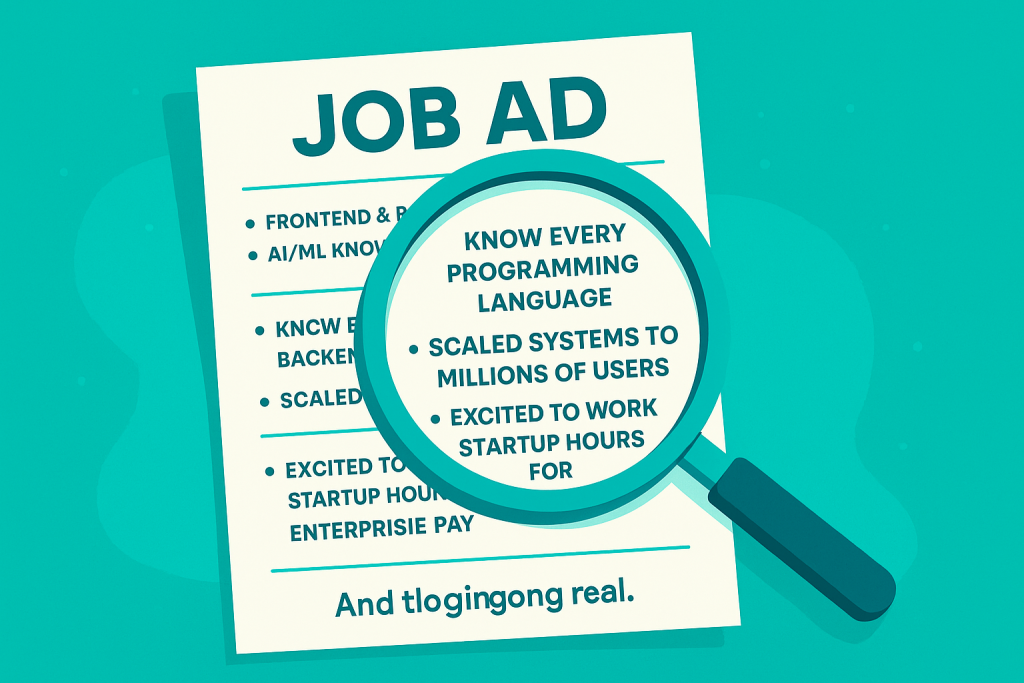
Somewhere between the 9th interview round and the 14th must-have bullet point, a lot of companies quietly lose the people they were hoping to hire.
Not because there’s no talent.
But because they’re chasing someone who doesn’t exist: The perfect engineer.
What the “Perfect” Engineer Looks Like (on Paper)
They know every language your stack touches—even the ones you’re planning to phase out.
They’ve scaled systems from 0 to millions, led teams, and are still hands-on coders
They love startups, but also want enterprise polish.
They want to be challenged, but not too much.
They’re local. Or remote. But definitely in your time zone.
They’re affordable.
And they’re not real.
What Happens When You Search for This Person
You write a job description that reads like three roles mashed into one
You get flooded with mismatched applicants
Your hiring team spends hours filtering, rejecting, and circling back
You finally talk to someone great—and lose them to a faster, more focused company
Meanwhile, you think it’s a “talent shortage.” But what’s really happening is you’re filtering out everyone who might actually be great because you’re holding out for an ideal that doesn’t exist.
How It Feels on the Candidate Side
Let’s flip the script.
Imagine you’re a backend developer with 7 years of solid experience. You’ve worked in microservices, dabbled in DevOps, led some projects. You see a job post looking for exactly that—but also:
Frontend expertise in React
AI/ML “nice to have”
Experience managing 12+ people
Based in Warsaw, fluent in English and German
Oh, and must be excited to work startup hours for enterprise pay
You’d skip it. And they do.
The Real Risk: Losing Good for the Sake of Perfect
We’ve seen it over and over: Teams waiting for the “perfect fit” often miss out on good people—ones who’d do the job well and actually join.
Good hiring is about fit, potential, and real-world needs—not fantasy checklists.
And when companies shift that mindset, everything gets easier:
Job posts attract the right kind of people
Interviews get more focused
Offers are accepted faster
Teams stop burning out waiting for “the one”
So What Should You Look For?
Instead of chasing perfection, ask:
What’s truly essential on day one?
What can be learned on the job?
What kind of person succeeds on this team, not just in general?
Great engineers come in different shapes—and the best ones often aren’t perfect on paper.
They’re curious. Adaptable. Reliable. And they’re out there—if you know how to look.
Where We Come In
At Meettal, we help tech teams get clear on what they actually need—and find people who match that.
Not resumes that check every box. Not unicorns. Just smart, capable humans who can build real things with you.
Hiring doesn’t have to be a never-ending search for perfect. It just has to be right. Let’s talk.
Some team members are just harder to work with… or are they?
In this insightful breakdown, Mariana Edilyan challenges the idea of “difficult” employees and offers practical advice on how to better understand and work with 15 different personality types that often cause friction in teams.
Whether you’re leading a team or simply navigating workplace dynamics, this resource is packed with actionable strategies to help you turn potential challenges into opportunities for growth.
Struggling to find the right leadership balance? These 10 powerful contrasts, suggested by Justin Wright, will help you lead with clarity, confidence, and compassion.
Have you ever wondered if your people are on the same page or not? You need to ask these 5 questions suggested byVince Sanderson to give you an insight.
Please reflect upon how you think the team would answer these questions, then ask them and then of course, compare your results.
5 questions to find out if your team members are on the same page
1. If we interviewed each team member separately would they give similar answer about the team goals, priorities and vision?
Meaning if you would ask each one separately about strategy of the team, goals and objections, about what priorities you all have as a team for this year and for upcoming year, what would be the answers, here the most important thing to see how similar or how close the answers are.
2. Do team members have a collective understanding of the role, other’s roles and where they connect?
In this case it is very important that each team member would have a clear understanding about their own role in the team and then next important team is that every team member should know the functions and responsibilities of his/her colleagues and role in the whole team picture. Of course vitally important is that everyone see how all these roles are connected within the team.
3. Do they know who knows what?
Every team member has unique knowledge and experience and it is important that members of one team really know about each other’s areas of expertise.
4. If your team faced a significant challenge next month, would each person know what they need to do?
There always will be different problems and issues to solve, and it is important that your team members clearly know what each of them should do in case there is a significant challenge.
5. When problems arise do they have a clear process to voice their concerns and realign their efforts?
This question refers to clear processes in your company and in your team for problematic and complex cases. Is there a platform where employees can voice their issues? Do you have clear mechanism and procedures so that problems are solved in a fair and structured way.
Reflect upon about how the team would answer these questions, then ask them and then compare the two.
HR professionals must possess strong emotional intelligence, team management skills, leadership abilities, and a deep understanding of employee motivation. Animated films can offer valuable insights into these key HR competencies. Here are five animated movies that provide essential lessons for HR professionals.
1. Inside Out (2015)
Key Themes:
Emotional Intelligence (EQ)
Workplace Stress Management
Adaptability to Change
What HR Can Learn from This Movie
This film visually represents how different emotions influence people’s behavior and decision-making. HR professionals should develop a keen understanding of employees’ emotional states and foster psychological safety in the workplace.
Skills to Develop:
Empathy and understanding employee needs
Enhancing emotional intelligence
Flexibility and adaptability to change
2. Soul (2020)
Key Themes:
Meaning of Work and Self-Realization
Motivation and Career Satisfaction
Work-Life Balance
What HR Can Learn from This Movie
“Soul” highlights how people often chase an “ideal career” while neglecting true fulfillment. HR professionals should support employees in finding their passion, preventing burnout, and creating opportunities for growth.
Skills to Develop:
Identifying true employee motivation
Promoting work-life balance
Creating self-development opportunities in the workplace
3. Zootopia (2016)
Key Themes:
Diversity, Equity, and Inclusion (D&I)
Overcoming Stereotypes
Cultural Intelligence
What HR Can Learn from This Movie
The movie demonstrates how discrimination and biases hinder individual growth. HR professionals must ensure equal opportunities in the workplace and foster a culture that embraces diversity and inclusion.
Skills to Develop:
Managing workplace diversity
Enhancing inclusion within the organization
Developing fair and unbiased HR policies
4. The Incredibles (2004)
Key Themes:
Teamwork
Managing Individual Talents
Work-Life Balance
What HR Can Learn from This Movie
Each individual has unique strengths and weaknesses. This film highlights the importance of properly managing team members’ unique skills while also encouraging a balance between work and personal life.
Skills to Develop:
Building and unifying teams
Recognizing employees’ strengths
Conflict resolution in teams
5. Ratatouille (2007)
Key Themes:
Discovering New Talent
Creating Opportunities for Everyone
Organizational Growth Strategies
What HR Can Learn from This Movie
The movie teaches that talent knows no boundaries. HR professionals should be able to recognize and nurture hidden talents, regardless of background or experience.
As a tech recruiter, one of the most challenging aspects of my job is negotiating with top talent in the industry. The competition is brutal, and it takes more than just offering a generous salary package and a bunch of benefits to be able to hire talent. It requires a set of negotiation tactics that can help to attract and recruit the best tech professionals.
I want to share some effective negotiation tactics that have helped me secure strong tech talent for my clients. These tactics are mirroring, tactical empathy, and labeling the candidate’s emotions.
Mirroring: building rapport and establishing trust
Mirroring is a subtle technique that involves mimicking the other person’s body language, tone of voice, and choice of words to build rapport and establish trust. It can make the candidate feel more comfortable and relaxed, reducing tension and creating a favorable negotiating environment.
To effectively mirror a candidate, you need to pay attention to their tone of voice and choice of words.
At the earlier stages of the recruitment process, you have written text (reach-out messages) or phone/video calls as your only way to communicate with the potential candidate.
Since you don’t see each other in person, as a recruiter, you should focus more on their choice of words and their tone of voice. However, be careful when matching someone else’s tone of voice. If they sound frustrated or aggressive, your tone of voice should remain calm and balanced. So instead of mimicking them, try to establish trust with a calm and measured attitude.
Matching the tone of voice
Matching someone’s tone of voice starts with analyzing their communication style. Before I even start writing to the candidate, I take a moment to explore their style. I look at the language they use when posting on LinkedIn or other social media channels or when replying to comments or posts. This gives me a pretty good understanding of how the candidate likes to communicate.
Once I have analyzed the candidate’s communication style, I try to use a similar language style when writing to them. I use words and phrases they are familiar with, and I try to use a similar tone and voice.
However, keeping it professional is key since you represent a company, and the candidate probably doesn’t know you in person.
Another key aspect of matching someone’s tone of voice is ensuring your message is clear and concise. This means I avoid complex language or technical jargon unless the person uses them themselves.
Lastly, when matching someone else’s tone of voice, it’s important not to lose yours or fake a communication style. It’s not about duplicating the other person’s style; it’s more about finding common ground that works for both of you.
Tactical empathy: understanding the candidate’s perspective
Tactical empathy is putting yourself in the candidate’s shoes and understanding their perspective. By doing this, you can gain valuable insights into what motivates them, what their concerns are, and what they are looking for in a job. This information can help you tailor your negotiation approach to meet their needs and interests better.
To practice tactical empathy, I do active listening. I pay close attention to what the candidate is saying. I then ask open-ended questions encouraging them to share more about their perspective. The more I learn about their attitude, objections, concerns, and needs, the better I can tailor my negotiation approach.
I sometimes also use one of the so-called reflective listening techniques – I summarize what they have said and check if I have understood their point of view correctly. For example, “I don’t want to change my job right now. I am happy doing what I do in my current company especially considering that they are a growing startup and I got a big stock share there.” I could add to this, “It seems it’s not an easy decision to leave a startup that offers you an interesting job and great stock options.”
Instead of jumping into bringing arguments and shouting about facts on why they should leave their current job, I summarize what they say, and this helps the candidate feel heard.
Labeling the candidate’s emotions: validating their feelings
We all experience emotions, whether positive or negative, about our jobs. Labeling the candidate’s emotions involves validating their positive and negative feelings. By doing this, I show the candidate that I understand and respect their emotions. This helps me build trust and strengthen my relationship with the person I am in contact with.
When talking to the candidate, I pay close attention to their verbal and nonverbal cues (if the conversation happens in person). When I notice the candidate is experiencing a particular emotion, I try to label it by saying something like, “It sounds like you value work-life balance a lot” or “It sounds like you feel excited about an opportunity where you can take the lead on X, Y, Z” or “It looks like you are frustrated by the lack of proper processes for managing X, Y, Z.”
By doing this, I am demonstrating empathy and showing that I am paying attention to their concerns. This can help to build trust. Later, when the time is right, I can use all that has been said to me to try and “sell” the work-life balance or the nicely-established processes in a company I am offering them to join.
Final notes
Mirroring, tactical empathy, and labeling the candidate’s emotions are great negotiation tactics I use regularly. However, the key point for success here is that I don’t rush their decision-making. I’ve had candidates on my radar for months, if not years, whom I’ve been in constant contact with. I kept listening to their perspective and gathering insights about them until I could offer them the right opportunity that would minimize their objections (that I already knew of) and maximize the possibility of them agreeing to attend an interview or speak with my client.
Why Hire Female Leaders (especially in a small market)
How many women do you know in leadership positions? Are they good? How do you feel about having more female leaders in a small market like Armenia?
In small markets, gender diversity is still a pretty sensitive topic. We don’t talk about it enough.
However, women bring a set of unique values to organizations. And I feel strongly about hiring them.
Gender diversity and inclusion are critical issues that have started being addressed in certain areas of the world. However, despite progress in many fields, discrimination against women in small markets still prevails.
Women often face unique challenges that most men do not – for example, they are often perceived as too emotional, not confident, or assertive enough.
As a female leader, it takes a lot of effort to get business-critical decisions approved. You need to provide enough context and enough evidence to make your voice heard and your judgment supported by other women and men equally.
Additionally, you often have to explain things (and yourself), unlike men whose thinking or decisions are not questioned so often. To be fair, a lot of male leaders do support women. But, as a female leader, I’ve heard things like, “Yes, problems exist, but don’t overthink them. Just act and do what you are good at.”
My understanding is that you overcome a problem by thinking it through, speaking it out, and opening up a conversation around it. Experiencing a problem and ignoring its existence is like hiding an elephant in a room, isn’t it?
So here is the problem – as a woman leading a tech recruitment agency in a small market, I think not believing in women and not giving them the chance to lead teams is a huge mistake based on gender bias.
Why should business owners or managers in a small market consider hiring women? The answer is – women bring a unique perspective and skillset to the table that can help a business grow and thrive.
Women are often better at addressing the unique needs of female employees
One of the first housekeeping and women-centric decisions I made when I joined meettal was introducing period leave for women and adding hygiene products for women in the office. These two simple yet oftentimes overlooked little perks usually make a big difference for women employees by significantly affecting their comfort and productivity.
Employee engagement is boosted
Research shows that companies with more women in leadership positions have higher levels of employee engagement. This is because women tend to be more collaborative and inclusive, which creates a positive work environment. Employees who feel valued and included are more likely to be motivated to perform their best work.
Women in top leadership roles increase productivity and earnings
Studies have also shown that companies with more women in leadership positions tend to have better financial performance.
A study by Credit Suisse concluded that companies with 25% of women in decision-making roles had a 4% higher average return on investment, and companies with 50% of women in senior leadership had a 10% higher cash flow return on investment.
This is likely because female leaders tend to be more risk-averse and focus on long-term goals, which can lead to more sustainable growth.
Female leaders bring a diversity of thought to the table
Women have historically been underrepresented in leadership positions. That’s why now they bring a unique perspective to the table – ideas and values never really heard of before, especially in male-dominated markets.
While it may take us, women, more time to validate a decision, our unique values can lead to a better workplace environment, improved employee morale, and boosted work ethics. Because we have to explain our choices so often, we are often more careful and thoughtful in our decision-making, which can result in more long-term success for a business.
Disclaimer: representation matters, but it’s not a rule
Having women in leadership positions is a powerful message that women, too, can achieve their career goals. However, breaking down barriers and creating a more diverse workforce might not be the top priority for an average business in a small market.
For business owners, a few business-critical priorities are employee engagement and productivity and higher return on investment. If a female leader can get the business there, they should be given the chance to do that.
I am by no means arguing that women lead better than men do. However, women should be provided an equal opportunity to lead and help a business thrive. Because, more often than not, women prove to be great at doing that.
Meettal helps tech companies hire senior tech talent across Armenia, the UAE, the US, Europe, Singapore, Australia and Taiwan. Twenty minutes with our team – we tell you honestly whether we can help.


 For more insights follow





 For more insights follow


